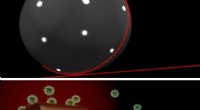
* Molecules: This is called Rayleigh scattering, and it's what makes the sky blue. Air molecules (nitrogen and oxygen) are much smaller than the wavelength of visible light, so they scatter shorter wavelengths (blue) more strongly than longer ones (red).
* Larger particles: This is called Mie scattering, and it's responsible for the white color of clouds. Cloud droplets and dust particles are comparable in size to the wavelength of visible light, so they scatter all wavelengths equally.
* Surfaces: Light scattering can also occur when light strikes a surface, such as a mirror or a rough wall. This is called specular reflection (mirrors) or diffuse reflection (rough surfaces).
So, the answer depends on the context:
* For the blue sky: Air molecules
* For clouds: Water droplets and dust
* For reflections: Surfaces of objects
Key takeaway: Light doesn't scatter off of a specific substance, but rather any particle or surface it encounters. The type of scattering and the colors involved depend on the size of the particle relative to the wavelength of light.