Gases
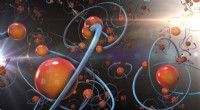
* High Kinetic Energy: Gas particles have the highest kinetic energy of the three states of matter (solid, liquid, gas). They move rapidly in random directions, constantly colliding with each other and the walls of their container.
* Large Distances Between Particles: Gas particles are spread far apart, with very little attraction between them. This means there's a lot of empty space between particles.
* Compressibility: Because of the large distances between particles, gases can be easily compressed. Applying pressure forces the particles closer together.
* Indefinite Shape and Volume: Gases take the shape and volume of their container because the particles are free to move around without much restriction.
Liquids
* Moderate Kinetic Energy: Liquid particles have less kinetic energy than gas particles, but more than solid particles. They move around more freely than solids but are more confined than gases.
* Smaller Distances Between Particles: Liquid particles are closer together than gas particles and have stronger attractive forces between them.
* Incompressibility: Liquids are much less compressible than gases. Their particles are already relatively close together, so applying pressure has less of an effect on their volume.
* Indefinite Shape but Definite Volume: Liquids take the shape of their container, but they maintain a constant volume. The particles can slide past each other, but they are still relatively close together.
Here's a table summarizing the key differences:
| Feature | Gas | Liquid | Solid |
|-----------------------|-------------------------|--------------------------|------------------------|
| Particle Spacing | Very far apart | Closer together | Very close together |
| Particle Motion | Rapid, random, free | Moderate, random, some freedom | Vibrational only |
| Compressibility | High | Low | Very low |
| Shape | Indefinite | Indefinite | Definite |
| Volume | Indefinite | Definite | Definite |
In a nutshell:
* Gases: Think of particles bouncing around like a room full of ping pong balls.
* Liquids: Imagine marbles in a jar – they can move around, but they're more confined.
* Solids: Picture bricks in a wall – they can only vibrate in place.