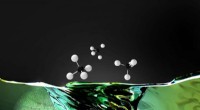
* Hexane (C6H14) is a nonpolar molecule: It consists of only carbon and hydrogen atoms, which have similar electronegativity. This means the electrons are shared almost equally, resulting in no significant charge separation within the molecule.
* Water (H2O) is a polar molecule: Oxygen is more electronegative than hydrogen, leading to a partial negative charge on the oxygen atom and partial positive charges on the hydrogen atoms. This creates a dipole moment, making water polar.
"Like dissolves like": This principle states that substances with similar polarities tend to dissolve in each other. Since hexane is nonpolar and water is polar, they are not compatible.
Intermolecular forces:
* Hexane primarily relies on London dispersion forces, weak temporary attractions between molecules due to temporary fluctuations in electron distribution.
* Water uses strong hydrogen bonding, a special type of dipole-dipole interaction where hydrogen atoms are attracted to highly electronegative atoms like oxygen.
The strong hydrogen bonds in water are much more difficult to overcome by the weak London dispersion forces in hexane. This prevents the two substances from forming a homogeneous mixture, and they separate into distinct layers.