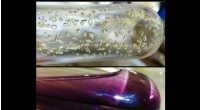
Here are some examples:
* Metal hydroxides: These are ionic compounds that contain a metal cation and the hydroxide anion (OH-). Examples include sodium hydroxide (NaOH), potassium hydroxide (KOH), and calcium hydroxide (Ca(OH)2).
* Some non-metal oxides: Certain non-metal oxides react with water to form acids, which then release hydroxide ions. For example, sulfur dioxide (SO2) reacts with water to form sulfurous acid (H2SO3), which then releases hydroxide ions.
* Ammonium hydroxide (NH4OH): While not a true hydroxide, ammonium hydroxide is a weak base that forms ammonium ions (NH4+) and hydroxide ions (OH-) in solution.
The ability of a compound to form hydroxide ions in solution is what makes it a base. Bases are characterized by their slippery feel, bitter taste, and ability to neutralize acids.






![Self-Sorting Achieved Through Molecular Geometry of Pillar[n]Arenes](https://www.scienceaq.com/article/uploadfiles/202110/2021102312082264_S.jpg)