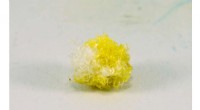
1. Cesium metal (Cs): The cesium ions (Cs+) in the solution are reduced at the cathode, gaining electrons to form cesium metal.
2. Bromine gas (Br2): The bromide ions (Br-) in the solution are oxidized at the anode, losing electrons to form bromine gas.
3. Hydrogen gas (H2): Since the solution is aqueous, water molecules are also present. Water can be reduced at the cathode to form hydrogen gas.
Overall reaction:
2CsBr(aq) + 2H2O(l) → 2Cs(s) + Br2(g) + H2(g) + 2OH-(aq)