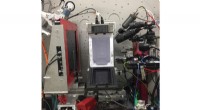
Digital camera image from in vitro cotton model after incorporation of exogenous molecules with new functionalities. Credit: Filipe Natalio
(Phys.org)—A team of researchers from Germany, Israel and Austria has developed a process for imbuing cotton fibers with material that glows under fluorescent light. In their paper published in the journal Science, the team describes their process, how well it works and other applications under which it might prove useful.
As scientists continue to look for ways to create wearable electronic products, some unique ideas have emerged. One of them is adding material to the water used by a growing cotton plant to endow it with desirable properties. In this new effort, the researchers found that by combining two molecules, one that is naturally carried by plants to its cells and another that causes fluorescence, they could produce plant fibers with fluorescent properties. That fiber could then be used the same way it has for thousands of years, to make cloth. In this case, cloth that glows under a fluorescent light.
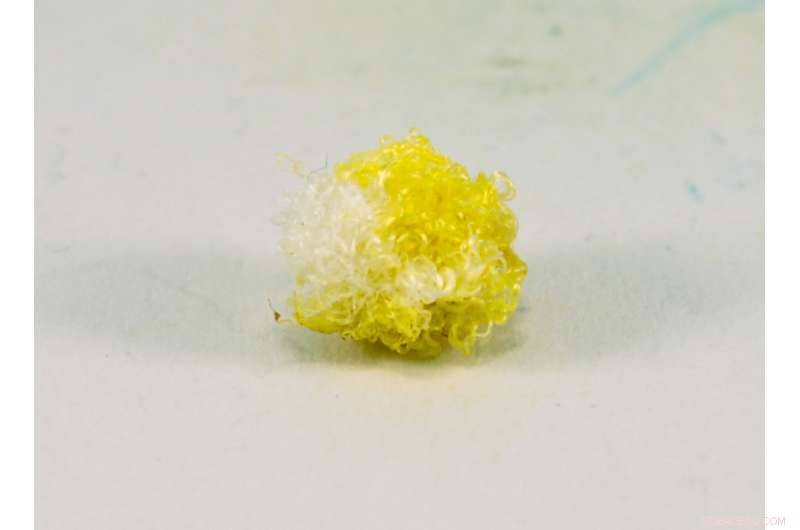
In practice, the researchers grew cotton plants in water, then harvested their ovules, which is the part of the plant that makes the fibers. They cultured the ovules separately and eventually fed them water doctored with the desired molecules. After 20 days, the cotton was harvested and tested. The researchers found that approximately 5 percent of the molecules had made their way to the fibers—enough to make them glow green when exposed to fluorescent light.
The team reports that they spent a significant amount of time testing the resulting cotton fibers to prove that the molecules were, indeed, inside the fiber cells and not just coating them—an important factor, because it means the molecules will not be carried away when the fabric is washed.
Besides the coolness factor, the process offers the possibility of adding other features to wearable materials. To demonstrate, the researchers used the same process to introduce a magnetic molecule instead of one with fluorescent properties, and created cotton cloth with magnetic properties. Magnetism in cloth, the group notes, could possibly be useful for storing data from electronic devices. They note that the process could also be used with other materials made from plants such as bamboo or flax.
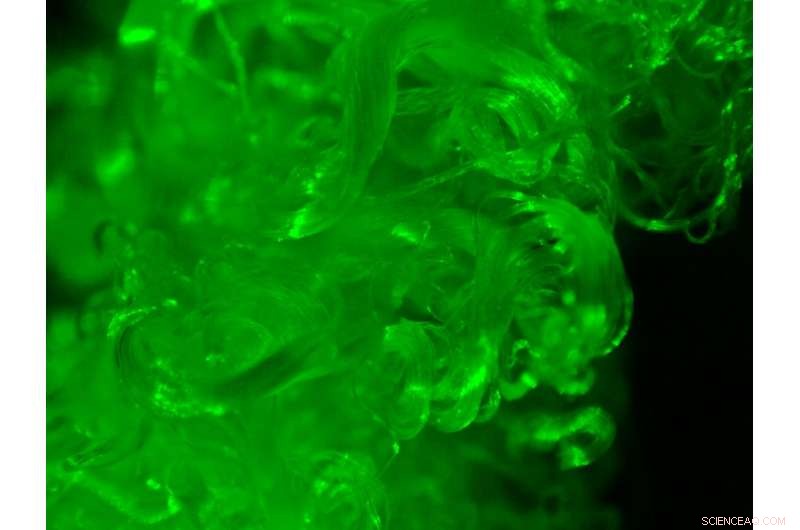
Microscopic image of the cotton fibers after incorporation of the fluorescent exogenous molecule. This image was taken under a binocular under UV light showing the fluorescent fibers. Credit: Filipe Natalio
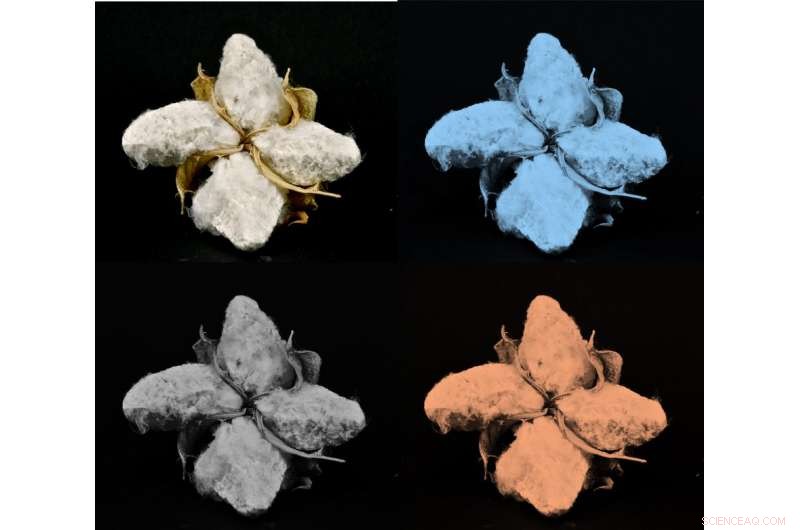
Image that shows a cotton fruit and different colors to show that we can provide functionalities to the cotton. Credit: Filipe Natalio
© 2017 Phys.org