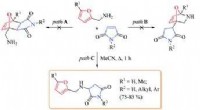
Reactants:
* The starting materials of a chemical reaction.
* They are substances that undergo a chemical transformation.
* They possess specific chemical bonds and structures.
* Their atoms are rearranged during the reaction.
Products:
* The substances formed as a result of a chemical reaction.
* They have different chemical bonds and structures than the reactants.
* Their formation represents the outcome of the reaction.
Relationship:
* Reactants are transformed into products through the breaking and forming of chemical bonds. This process involves rearranging atoms and their associated electrons.
* The chemical equation represents this transformation: The reactants are written on the left side of the equation, and the products are written on the right side, separated by an arrow.
* The law of conservation of mass dictates that the total mass of reactants must equal the total mass of products. This is because atoms are neither created nor destroyed in chemical reactions, only rearranged.
Examples:
* Combustion of methane: CH₄ (methane) + 2O₂ (oxygen) → CO₂ (carbon dioxide) + 2H₂O (water)
* Reactants: Methane and Oxygen
* Products: Carbon dioxide and water
* Synthesis of water: 2H₂ (hydrogen) + O₂ (oxygen) → 2H₂O (water)
* Reactants: Hydrogen and oxygen
* Products: Water
In summary: Reactants and products are inseparable parts of a chemical reaction. They are related by the chemical transformation that occurs, where reactants are consumed and products are formed. This transformation follows the law of conservation of mass, ensuring that the total mass remains constant throughout the reaction.