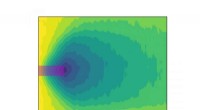
The arrangement of electrons around an atom's nucleus is governed by a set of rules based on quantum mechanics. Here's a breakdown:
1. Quantum Numbers:
* Principal Quantum Number (n): Describes the electron's energy level. Higher 'n' means higher energy. It can be any positive integer (1, 2, 3, ...), with 1 being the ground state.
* Angular Momentum or Azimuthal Quantum Number (l): Describes the shape of the electron's orbital. It ranges from 0 to n-1.
* l = 0: s orbital (spherical)
* l = 1: p orbital (dumbbell shaped)
* l = 2: d orbital (more complex shapes)
* l = 3: f orbital (even more complex shapes)
* Magnetic Quantum Number (ml): Describes the orientation of the orbital in space. It can take on values from -l to +l, including 0. So, for l = 1 (p orbitals), there are ml = -1, 0, +1, giving three p orbitals oriented along the x, y, and z axes.
* Spin Quantum Number (ms): Describes the intrinsic angular momentum of an electron, which is quantized and is often visualized as the electron "spinning." It can be either +1/2 or -1/2.
2. Aufbau Principle:
* Electrons fill orbitals in order of increasing energy.
* The order of filling is based on the diagonal rule (sometimes called the Madelung rule).
3. Pauli Exclusion Principle:
* No two electrons in an atom can have the same set of all four quantum numbers.
* This means each orbital can hold a maximum of two electrons, with opposite spins.
4. Hund's Rule:
* Within a subshell (e.g., the 2p subshell), electrons will individually occupy each orbital within that subshell before pairing up.
* This maximizes the number of unpaired electrons and minimizes electron-electron repulsion.
5. Electronic Configuration:
The arrangement of electrons in an atom is called its electronic configuration. It is written in the form:
(n)l^(number of electrons in that subshell)
For example, the electronic configuration of nitrogen is 1s² 2s² 2p³.
Example:
Let's look at the electronic configuration of oxygen (atomic number 8):
1. Aufbau Principle: Following the diagonal rule, we fill the orbitals in the order 1s, 2s, 2p.
2. Pauli Exclusion Principle: Each orbital can hold a maximum of two electrons with opposite spins.
3. Hund's Rule: Within the 2p subshell, we place one electron in each of the three 2p orbitals before pairing up any electrons.
Therefore, the electronic configuration of oxygen is: 1s² 2s² 2p⁴
Note: These rules provide a framework for understanding how electrons are distributed around the nucleus. However, the behavior of electrons is complex and quantum mechanics plays a significant role in explaining their behavior.