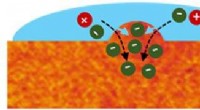
* Water is a polar molecule: It has a slightly positive end and a slightly negative end, creating a dipole. This polarity allows water to attract other polar molecules and ions.
* "Like dissolves like": Polar substances tend to dissolve in other polar substances, and nonpolar substances tend to dissolve in other nonpolar substances.
Here are some examples of substances that are least likely to dissolve in water:
* Oils and fats: These are made up of long chains of hydrocarbons, which are nonpolar.
* Waxes: Similar to oils and fats, they are nonpolar.
* Many organic compounds: Compounds containing long chains of carbon and hydrogen, like hydrocarbons, are generally nonpolar.
* Gases: While some gases dissolve in water (like carbon dioxide), many are nonpolar and therefore poorly soluble.
Think of it this way: Imagine trying to mix oil and water. They don't mix because oil is nonpolar and water is polar. The same principle applies to other nonpolar substances.