Here's how it works:
1. Excitation: The sample is irradiated with UV or visible light.
2. Absorption: Certain molecules in the sample absorb the light energy, causing their electrons to jump to higher energy levels.
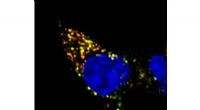
3. Fluorescence: The excited electrons quickly return to their ground state, releasing the absorbed energy as photons of light. These emitted photons have a longer wavelength (lower energy) than the absorbed light, which is why fluorescence is often observed as a different color than the excitation light.
4. Detection: The emitted fluorescence is collected and analyzed to provide information about the sample.
Key points:
* The specific wavelength of excitation light is chosen to match the absorption spectrum of the molecule being studied.
* Different molecules emit fluorescence at different wavelengths, allowing for identification and quantification of various components in a sample.
* Fluorescence spectroscopy is a highly sensitive technique, making it useful for studying trace amounts of molecules.