Here's why:
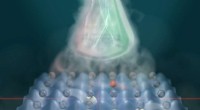
* The nucleus: The nucleus of an atom is incredibly dense, containing protons and neutrons. It accounts for nearly all of the atom's mass. However, the nucleus is incredibly small compared to the overall size of the atom.
* Electrons: Electrons are much smaller than protons and neutrons and orbit the nucleus at a relatively large distance. This creates a vast amount of empty space within the atom.
* Quantum mechanics: Electrons don't have fixed orbits, but rather exist in probability clouds called orbitals. These orbitals describe the regions where electrons are most likely to be found. This further emphasizes the concept of empty space within an atom.
Analogy: Imagine a stadium with a tiny marble in the center (the nucleus). The marble would represent the majority of the mass, but the vast empty space around it would represent the majority of the volume.
While atoms are mostly empty space, the tiny nucleus and the electrons within the atom create a powerful force that governs chemical interactions and the properties of matter.