Here's why:
* Homogeneous: This means the mixture has a uniform composition throughout. You can't easily distinguish the different components.
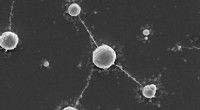
* Suspended particles: These are particles that are larger than those found in a solution but smaller than those in a suspension. They are dispersed evenly throughout the mixture but are not fully dissolved.
Examples of colloids:
* Milk: Fat globules are suspended in water.
* Fog: Tiny water droplets are suspended in air.
* Jello: Gelatin molecules are suspended in water.
* Paint: Pigments are suspended in a liquid.
Key characteristics of colloids:
* Tyndall effect: Colloids scatter light, making a beam visible (think of a sunbeam shining through fog).
* Stable: The particles remain suspended for a long time.
* Heterogeneous at the nanoscale: While appearing homogeneous to the naked eye, colloids are actually heterogeneous at the molecular level.
Let me know if you have any more questions!