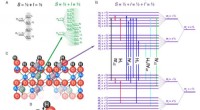
1. Electronic Configuration:
- They are located in Groups 3-12 of the periodic table, between the s-block and p-block elements.
- Their defining feature is the presence of partially filled d orbitals in their atoms. This is where they get their name, as their electron configurations "transition" between the filled d orbitals of the previous group and the filled d orbitals of the next group.
- They have a variable number of valence electrons, which can be involved in bonding. This allows them to form multiple oxidation states, contributing to their diverse chemical behavior.
2. Physical Properties:
- High melting and boiling points: Due to strong metallic bonding, transition metals are generally hard and dense with high melting and boiling points.
- Good conductors of heat and electricity: Their d electrons contribute to their excellent conductivity.
- Lustrous appearance: Most transition metals have a shiny metallic luster.
- Malleability and ductility: Many are malleable (can be hammered into thin sheets) and ductile (can be drawn into wires).
3. Chemical Properties:
- Variable oxidation states: As mentioned, they can exist in multiple oxidation states, resulting in a wide array of chemical compounds.
- Form colored compounds: Many transition metal compounds are colored due to the d-d transitions that occur when electrons absorb and emit light. This is why we see a variety of colors in gemstones and other materials.
- Catalytic activity: They are often excellent catalysts due to their ability to change oxidation states readily, facilitating chemical reactions.
- Form complex ions: Their ability to form coordinate covalent bonds with ligands (electron pair donors) leads to the formation of complex ions.
- Paramagnetism: Many transition metals exhibit paramagnetism, meaning they are weakly attracted to magnetic fields due to unpaired electrons in their d orbitals. Some, like iron, cobalt, and nickel, are ferromagnetic, meaning they retain their magnetization even after the magnetic field is removed.
4. Applications:
- Metals and alloys: Used in construction, machinery, electronics, and more.
- Catalysts: Used in various industrial processes, like the production of gasoline, plastics, and pharmaceuticals.
- Pigments and dyes: Used in paints, inks, and textiles.
- Gemstones: Many transition metals are responsible for the vibrant colors of gemstones.
- Biomolecules: Transition metals like iron and copper play vital roles in biological systems.
Examples:
- Iron (Fe): Used in steel and other alloys, as well as in blood for oxygen transport.
- Copper (Cu): Used in electrical wiring, plumbing, and coins.
- Nickel (Ni): Used in batteries, coins, and alloys.
- Gold (Au): Used in jewelry, electronics, and dentistry.
- Titanium (Ti): Used in aerospace applications and medical implants.
It's important to remember that there are exceptions to these general properties. Some transition metals might be less reactive than others, or have different colors or melting points. The specific properties of each transition metal are influenced by its electronic configuration and other factors.