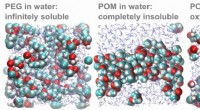
The dissolution of hydrogen peroxide in water is a physical process that involves intermolecular interactions between the polar molecules of hydrogen peroxide and water molecules. Hydrogen peroxide is a polar molecule due to the difference in electronegativity between oxygen and hydrogen atoms. The oxygen atoms in hydrogen peroxide have a partial negative charge (δ-), while the hydrogen atoms have a partial positive charge (δ+).
When hydrogen peroxide is added to water, the polar water molecules align and interact with the polar hydrogen peroxide molecules through dipole-dipole interactions. The partial positive charge of hydrogen atoms in hydrogen peroxide is attracted to the partial negative charge of oxygen atoms in water, and vice versa. These intermolecular interactions lead to the dissolution of hydrogen peroxide in water.
The dissolution of hydrogen peroxide in water is also influenced by other factors such as temperature and pressure. Generally, the solubility of hydrogen peroxide increases with increasing temperature and decreases with increasing pressure. At higher temperatures, the increased kinetic energy of water molecules overcomes the intermolecular interactions between hydrogen peroxide molecules, leading to a higher degree of dissolution. On the other hand, higher pressure favors the formation of hydrogen peroxide clusters, resulting in decreased solubility.