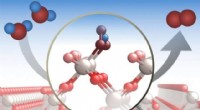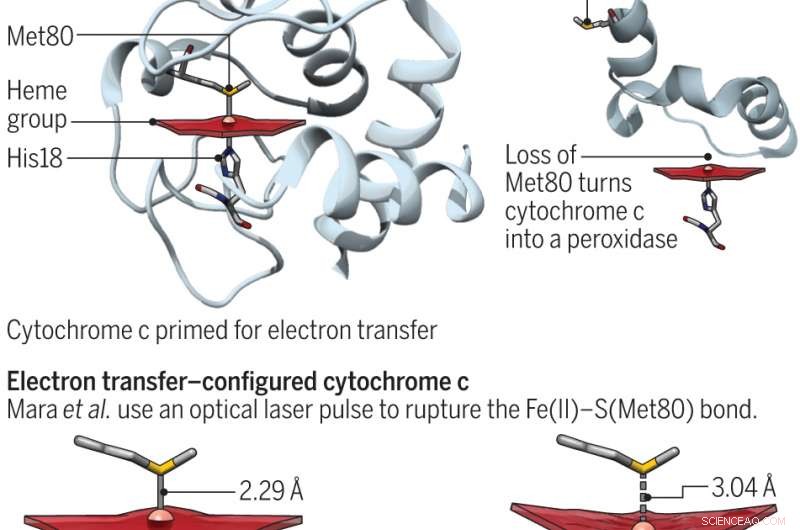
A change in the active-site conformation turns cytochrome c from an electron shuttle in respiration to a peroxidase enzyme for apoptosis. Credit: (c) Science 23 Jun 2017: Vol. 356, Issue 6344, pp. 1236 , DOI: 10.1126/science.aan5587
(Phys.org)—A team of researchers at Stanford University has used ultrafast x-ray absorption and emission spectroscopy to quantify the entatic state of cytochrome c. In their paper published in the journal Science, the group outlines their procedure and what they learned. Kara Bren and Emma Raven with the University of Rochester and University of Leicester respectively offer a Perspective piece on the work done by the team in the same journal issue, and outline some of the implications regarding the role that the protein plays in cell life and death.
Cytochrome c is a protein that exists in many plants, animals and unicellular organisms. In humans, its main purposes are ferrying electrons in mitochondria and assisting with apoptosis (normal cell death and the processes surrounding it.) These two functions have been shown in prior efforts to rely on the position of methionine residue. When sulfur works with iron, the protein is ready to transfer electrons. Otherwise, it engages in peroxidase activities. In this new effort, the researchers sought to better understand the energetics of the protein by probing the iron and sulfur bond. Entatic states, Bren and Raven point out, are very important in bioinorganic chemistry—it actually translates to something that is stretched when subjected to tension.
To better understand the bond between the two elements, the researchers temporarily forced them apart using a Linac Coherent Light Source X-ray free electron laser and then timed how long it took the two components to reform using iron X-ray emission spectroscopy. They found that the environment in which they existed boosted bond strength by four kilocalories per mole, which was enough to allow the protein to toggle between its functional states and to quantify the energy cost of the entatic state.
As Bren and Raven note, the results of the study have implications regarding the role that cytochrome plays in respiration, which they relate to living and apoptosis, which they relate to death. To promote continued living the protein helps to maintain a certain reduction potential. For apoptosis, the entatic state is disrupted allowing peroxidase activity to be enhanced.
© 2017 Phys.org