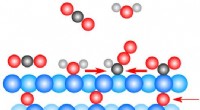
Boron does not react directly with water at room temperature and pressure. It exhibits an inert behavior to avoid contact with water, due to the formation of an oxygen-based protective layer of boron oxide (B2O3) on its surface that acts as a physical barrier. This passivation mechanism is common for many group 13 elements and prevents further interactions with water or chemical species in the environment. However, higher temperatures play a role.
B + 3H2O → H3BO3 + 3/2H2
This reaction yields boric acid (H3BO3) and hydrogen gas (H2).