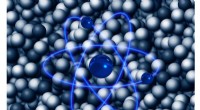
1. Uranium-235: This is a fissile isotope of uranium that is used in the majority of nuclear weapons. When a neutron is absorbed by a uranium-235 atom, the atom splits into two smaller atoms, releasing a great amount of energy and more neutrons. This process, called nuclear fission, can cause a chain reaction that results in a tremendous explosion.
2. Plutonium-239: This is another fissile isotope that can be used in nuclear weapons. It is produced artificially by irradiating uranium-238 with neutrons in a nuclear reactor. Plutonium-239 is less abundant than uranium-235, but it is also more efficient in producing nuclear fission.
3. Tritium: This is a radioactive isotope of hydrogen that is used in some nuclear weapons to boost their power. Tritium can be combined with deuterium, another isotope of hydrogen, to create a fusion reaction that releases a large amount of energy.
These radioactive materials are typically used in combination with conventional explosives to create a nuclear weapon. The conventional explosives are used to compress the fissile material, which brings it to a critical mass and initiates the nuclear chain reaction. The radioactive material then releases a tremendous amount of energy, causing the explosion.