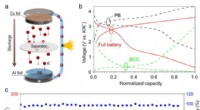
When zinc and copper are connected in a circuit, the following reactions occur:
1. Oxidation at the Zinc Electrode (Anode):
Zn(s) → Zn^(2+) (aq) + 2e-
Zinc atoms lose two electrons and dissolve into the electrolyte as positively charged zinc ions (Zn^(2+)). These electrons become available in the circuit.
2. Reduction at the Copper Electrode (Cathode):
Cu^(2+) (aq) + 2e- → Cu(s)
Copper ions in the electrolyte gain two electrons from the circuit and get deposited as copper atoms on the copper electrode.
This redox reaction creates a potential difference between the zinc and copper electrodes. The zinc electrode becomes negatively charged due to the excess electrons, while the copper electrode becomes positively charged due to the copper ions attracting the electrons. This potential difference drives the flow of electrons in the circuit, generating an electric current.
The strength of the voltage produced depends on the difference in reduction potentials between the anode and cathode materials. In this case, the standard reduction potential of Zn^(2+) / Zn is -0.76 V, while that of Cu^(2+) / Cu is +0.34 V. The overall cell voltage is approximately the difference between these potentials, which is around 1.1 V.
Using other metals with more extreme standard reduction potentials can yield higher voltage outputs from voltaic cells.