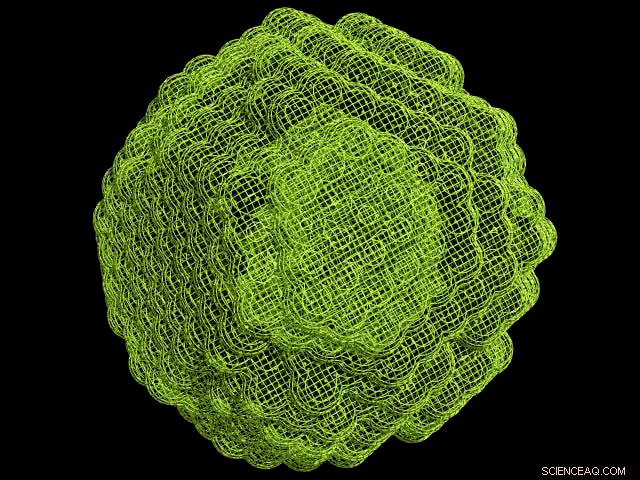
This image illustrates that, as iron oxide undergoes oxidation, voids in the nanoparticles merge to form crescents. Credit: Alexandra Kirby / Y. Sun et al. / Science (2017)
(Phys.org)—A team of researchers affiliated with Temple University and Argonne National Laboratory has developed a way to observe material restructuring at the atomic scale in real time. In their paper published in the journal Science, the team describes their technique and what they observed as they followed the progression of oxidation at the atomic scale. Doris Cadavid and Andreu Cabot with Catalonia Institute for Energy Research offer a Perspective piece on the work done by the team in the same journal issue, and also outline the history and difficulties associated with observing atomic-level changes occurring in a material. They note also that the newly developed technique is likely to have a major impact on how metals and other compounds are engineered in the future.
Humans have known for thousands of years, as Cadavid and Cabot note, that materials decompose, burn or rust, and have learned more recently that such changes occur at the atomic level. To learn more about such processes, scientists have studied them in depth, but have been partially limited by an inability to actually watch what happens at the atomic level. That may be changing, as the researchers with this new effort have developed a way to watch oxidation occurring at the atomic level in real time.
The method involved combining a small-angling X-ray scattering technique with molecular modeling software to track in precise detail the oxidation process of iron oxide nanoparticles—all in real time.
The technique allowed the researchers to see that empty spaces would form at the onset of the process, which fused together when they grew to a certain size, creating other larger crescent-shaped empty spaces. They also found that they could control the diffusion process with the empty spaces by altering the temperature and size of the nanoparticles.
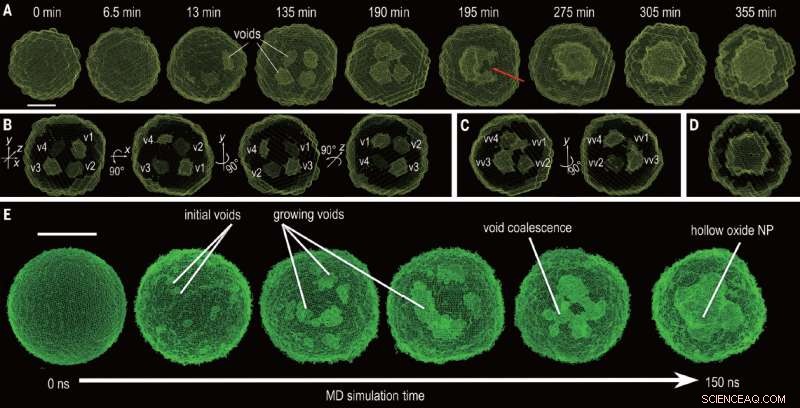
Snapshots of the 3-D structure of iron nanoparticles in the course of the oxidation process, captured through large-scale reactive molecular dynamic simulations. These simulations enhance our understanding of processes like oxidation and corrosion, and build a foundation for developing integrated imaging techniques to control or manipulate these types of reactions. Credit: Subramanian Sankaranarayanan, Badri Narayanan, Yugang Sun, Xiaobing Zuo, Sheng Peng and Ganesh Kamath. Argonne National Laboratory/Temple University
Cadavid and Cabot suggest that the technique may herald the dawn of a new era in chemistry—the ability to watch the process of solids being modified at the atomic scale in real time, or slowed down for fast reactions. It could lead, they suggest further, to better controlling such processes, including finding new ways to prevent metals from suffering damage due to rusting.
© 2017 Phys.org