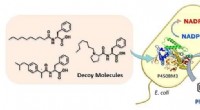
Inhibitors can work in a variety of ways, but the most common mechanism is by binding to an active site on an enzyme. This binding prevents the enzyme from catalyzing the reaction, which in turn slows down the overall reaction rate.
Inhibitors can be either reversible or irreversible. Reversible inhibitors bind to enzymes weakly and can be easily displaced, while irreversible inhibitors bind to enzymes strongly and cannot be easily displaced.
The strength of an inhibitor's binding to an enzyme is determined by a number of factors, including the structure of the inhibitor, the structure of the enzyme, and the reaction conditions.
Inhibitors are used in a wide variety of applications, including:
* Controlling the rate of chemical reactions in industrial processes
* Preventing the corrosion of metals
* Stopping the growth of bacteria and other microorganisms
* Treating medical conditions, such as cancer and HIV/AIDS
Inhibitors are an important tool for controlling chemical reactions and can be used to improve the efficiency of industrial processes, prevent damage to materials, and treat diseases.