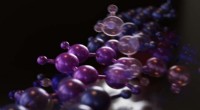
In an NH3 molecule, the nitrogen atom has a greater electronegativity than the hydrogen atoms. This means that the nitrogen atom attracts electrons more strongly than the hydrogen atoms, creating a partial negative charge on the nitrogen atom and a partial positive charge on each hydrogen atom. These partial charges create polar bonds between the nitrogen atom and each hydrogen atom.
The polarity of the NH3 molecule is also influenced by its molecular geometry. The nitrogen atom in NH3 is surrounded by three hydrogen atoms in a trigonal pyramidal arrangement. This geometry creates a dipole moment, which is a measure of the polarity of a molecule. The dipole moment of NH3 is directed from the nitrogen atom towards the center of the triangle formed by the hydrogen atoms.
The polarity of the NH3 molecule has several important consequences. For example, it allows NH3 to dissolve in water and other polar solvents. It also makes NH3 a good nucleophile, which means that it can donate electrons to other molecules.