Liquid crystals are materials that flow like liquids but have the molecular structure of crystals. They are used in a variety of applications, including liquid crystal displays (LCDs), because they can be easily switched from a clear to a turbid state by applying an electric field.
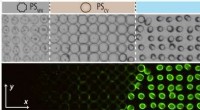
The new study, published in the journal Nature, shows that by adding small amounts of certain polymers to liquid crystals, it is possible to induce them to change shape in a controlled way. The researchers were able to make liquid crystals form droplets, rods, and other shapes, and to switch between these shapes by changing the temperature or the electric field.
This discovery has the potential to revolutionize a wide range of technologies. For example, it could be used to create new optical devices that can change shape on demand, such as adaptive lenses or switchable mirrors. It could also be used to develop self-healing materials that can repair themselves by changing shape, or dynamic displays that can change their images or colors in real time.
"We are very excited about the potential of this discovery," said study lead author Quan Li, a graduate student in the Department of Materials Science and Engineering at UC Berkeley. "We believe it could open up new possibilities for a wide range of applications."
The researchers are now working to understand the underlying physics of this phenomenon and to explore other ways to control the shape-shifting properties of liquid crystals.
"We are just beginning to scratch the surface of what is possible with this new technology," said study senior author Professor Nitin Goloksuz, a materials scientist and engineer at UC Berkeley. "We are eager to see what new and innovative applications can be developed."
The study was supported by the National Science Foundation and the Camille and Henry Dreyfus Foundation.