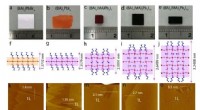
The team, led by professor Guihua Yu, found that water molecules can form clusters that act as barriers to the passage of other water molecules. This discovery could lead to the development of membranes that are highly selective for water, allowing for more efficient water purification and desalination.
"This is a fundamental discovery that could have a major impact on water purification and other applications," said Yu. "We are excited to explore the potential of this finding and to develop new technologies based on it."
The team's findings were published in the journal Nature Communications.
Water is a polar molecule, meaning it has a positive end and a negative end. When water molecules come into contact with a membrane, the positive ends of the molecules are attracted to the negative charges on the membrane, and the negative ends of the molecules are attracted to the positive charges on the membrane. This creates a barrier that prevents the water molecules from passing through the membrane.
The team found that the strength of this barrier depends on the concentration of water molecules in the solution. When the concentration of water molecules is high, the barrier is stronger and the water molecules are less likely to pass through the membrane. When the concentration of water molecules is low, the barrier is weaker and the water molecules are more likely to pass through the membrane.
The team also found that the temperature of the water can affect the strength of the barrier. When the temperature of the water is high, the barrier is weaker and the water molecules are more likely to pass through the membrane. When the temperature of the water is low, the barrier is stronger and the water molecules are less likely to pass through the membrane.
The team's discovery could lead to the development of highly selective membranes for water purification and other applications. These membranes could be used to remove impurities from water, such as salts, minerals, and bacteria. They could also be used to separate different types of molecules, such as oil and water.
The team is currently working on developing new membranes based on their discovery. They believe that these membranes could have a major impact on water purification and other applications.
The team's discovery is a fundamental breakthrough that could lead to the development of highly selective membranes for water purification and other applications. This could have a major impact on the world, as it could provide access to clean water for millions of people and reduce the amount of pollution caused by industrial processes.