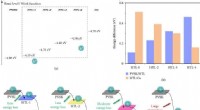
Identification of Electronic States: Photoionization experiments can reveal the various electronic states of a molecule. By irradiating the molecule with photons of different energies and observing the resulting ionization processes, spectroscopists can identify the energies and symmetries of the molecular orbitals involved. This information is crucial for understanding the electronic structure and bonding of the molecule.
Determination of Ionization Energies: Photoionization can accurately measure the ionization energies of molecules, which correspond to the energy required to remove an electron from a specific orbital. By analyzing the threshold energies at which ionization occurs, researchers can determine the ionization energies of different molecular orbitals. This information provides insights into the stability and chemical reactivity of the molecule.
Probing Vibrational and Rotational Structure: Photoionization can provide information about the vibrational and rotational energy levels of molecules. The ionization process can induce changes in these energy levels, resulting in the formation of vibrationally and rotationally excited ions. By analyzing the energy spacing and intensity patterns of the photoionization bands, spectroscopists can deduce the molecular vibrational frequencies and rotational constants. This information is essential for understanding the molecular structure and dynamics.
Exploring Molecular Dissociation Pathways: Photoionization can induce molecular dissociation, where the molecule breaks apart into smaller fragments. By studying the fragmentation patterns and the kinetic energy release of the fragments, researchers can gain insights into the molecular dissociation pathways. This information is valuable for understanding chemical reactions and the stability of molecular bonds.
Investigation of Rydberg States: Photoionization can access Rydberg states, which are highly excited electronic states where the electron is far from the molecular core. Rydberg states exhibit unique spectroscopic features and can provide information about the long-range interactions and electronic correlation within the molecule. Studying Rydberg states helps researchers understand the electronic structure and dynamics of complex molecular systems.
Complementing Theoretical Calculations: Photoionization experiments provide experimental data that can be compared with theoretical calculations. Computational methods, such as quantum chemistry, can predict molecular properties and spectra. By comparing the experimental photoionization data with theoretical predictions, researchers can validate and refine theoretical models, leading to a deeper understanding of molecular behavior.
In summary, photoionization spectroscopists provide a wealth of information about complex molecular potentials, including electronic states, ionization energies, vibrational and rotational structure, dissociation pathways, and Rydberg states. By combining experimental data with theoretical calculations, researchers gain a comprehensive understanding of the intricate behavior of molecules, which is essential for advancing our knowledge in chemistry, physics, and related disciplines.