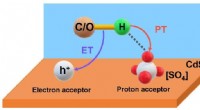
1. Light Absorption: When sunlight strikes the semiconductor material, such as TiO2, the energy from the photons is absorbed by the material's electrons. This causes the electrons to become excited and move from the valence band to the conduction band, creating a positively charged hole in the valence band.
2. Charge Separation: The excited electrons and positively charged holes migrate to opposite sides of the semiconductor material. The electrons move towards the surface of the material, while the holes move towards the interior.
3. Water Splitting: On the surface of the semiconductor material, the excited electrons react with water molecules. This reaction splits the water molecules into hydrogen ions (H+) and oxygen (O2).
4. Nitrogen Reduction: On the same surface, the positively charged holes react with nitrogen gas molecules. This reaction breaks the strong triple bond between nitrogen atoms in the N2 molecule, forming reactive nitrogen species.
5. Ammonia Formation: The hydrogen ions produced from water splitting react with the reactive nitrogen species to form ammonia. This reaction occurs on the surface of the semiconductor material, and the ammonia molecules are released into the surrounding environment.
The photocatalytic nitrogen fixation process can be optimized by controlling various factors such as the type of semiconductor material, the surface area of the material, the intensity of the light source, and the presence of additional catalysts or promoters. Research in this area is ongoing to improve the efficiency and practical applications of this technology for sustainable ammonia production.