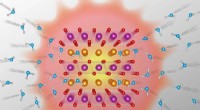
When an atom is impacted by a high-energy electron, some of the electron's energy can be transferred to the atom's electrons, causing them to become excited or even ionized (ejected from the atom). The energy required to ionize an atom is known as the ionization energy.
The ionization energy of an atom depends on a number of factors, including the energy of the incident electron and the number of electrons in the atom. For simple atoms, such as hydrogen, the ionization energy can be calculated relatively easily. However, for more complex atoms, such as those with many electrons, the calculations become much more difficult.
The new approach developed by the scientists uses a technique called the "density functional theory" (DFT). DFT is a quantum mechanical method that can be used to calculate the properties of atoms, molecules, and solids. The scientists used DFT to calculate the ionization energies of a number of atoms, including hydrogen, helium, and lithium.
The scientists found that their new approach was able to predict the ionization energies of the atoms with much greater accuracy than previous methods. This is because DFT takes into account the interactions between all of the electrons in the atom, which is important for accurately calculating the ionization energy.
The new approach could lead to more accurate predictions of how atoms behave in a variety of environments, including those found in plasmas and fusion reactors. This could be important for designing new materials and devices that can withstand the harsh conditions found in these environments.
In addition to its potential applications in plasma physics and fusion research, the new approach could also be used to study the properties of atoms and molecules in other fields, such as chemistry, biology, and materials science.