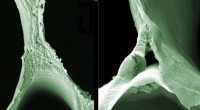
Now, a team of researchers from the University of California, Berkeley, and the University of California, Santa Barbara, has conducted a series of experiments and computer simulations that shed light on how order first appears in liquid crystals. Their findings, published today in the journal Nature Physics, provide a detailed picture of the process by which these materials transition from a disordered state to an ordered one.
"We were able to show that the ordering of liquid crystals occurs in a series of steps," said study lead author Daniel Beller, a graduate student in the Department of Materials Science and Engineering at UC Berkeley. "First, the molecules form small, local clusters that are randomly oriented. Then, these clusters begin to merge and align with each other until the entire liquid becomes a uniform, ordered phase."
The researchers observed this process by combining two different experimental techniques: polarized optical microscopy and X-ray scattering. Polarized optical microscopy allows researchers to visualize the orientation of the liquid crystal molecules, while X-ray scattering provides information about the structure and arrangement of the molecules. By combining these two techniques, the researchers were able to get a complete picture of the ordering process.
The findings of this study provide new insights into the fundamental behavior of liquid crystals and could have implications for the development of new technologies, such as liquid crystal displays and sensors.
"Understanding the mechanisms by which liquid crystals order is crucial for developing new materials that can be used in a variety of applications," said study senior author Nitash Balsara, a professor of materials science and engineering at UC Berkeley. "This study provides a foundation for future work in this area and could help to lead to the development of new liquid crystal-based technologies."