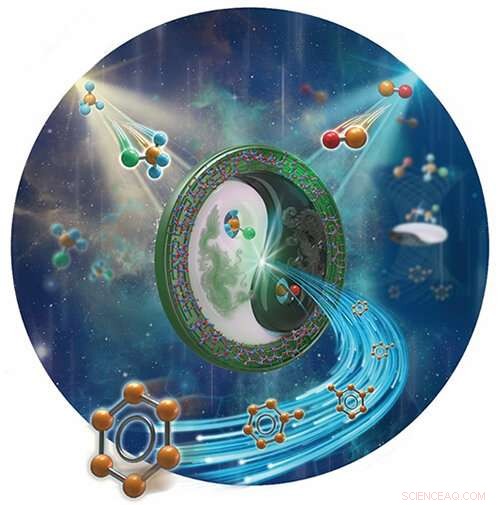
Highly enhanced aromatics selectivity by coupling of chloromethane and carbon monoxide over H-ZSM-5. Credit: Fang Xudong
Methane, the main constituent in shale gas and flammable ice, is expected to replace petroleum to produce high value-added chemicals such as aromatics.
Methane is relatively highly inert, which is caused by the high C-H bond strength and supersymmetric structure and hinders its applications.
Recently, a research team led by Prof. Liu Zhongmin and Prof. Zhu Wenliang from the Dalian Institute of Chemical Physics (DICP) of the Chinese Academy of Sciences (CAS) developed a strategy for the transformation of methane into aromatics by coupling of CH3Cl with CO over H-zeolites.
This study was published in Angewandte Chemie International Edition on Feb. 1.
The researchers used H-ZSM-5 as catalysts to achieve high aromatics selectivity as well as high selectivity of benzene, toluene, and xylene (BTX).
They found that the selectivity to aromatics increased from 39.0% to 79.3% after introducing CO, and the corresponding BTX selectivity increased from 17.7% to 48.0% at 2.0 MPa, 673 K. After optimizing reaction conditions, the aromatics selectivity reached as high as 82.2%, and BTX selectivity as high as 59.3%.
Moreover, they discovered that 2,3-dimethyl-2-cyclopentene-1-one (DMCPO) was generated from acetyl groups and olefins. And CO was proven to be inserted into the DMCPO and aromatics rings.
Then they proposed a new aromatization mechanism, including the formation of the above intermediates, which conspicuously weakened the hydrogen transfer reaction, resulting in an increase in aromatics selectivity and a drop in alkanes.
"Our study broadens approaches toward the transformation of methane into chemicals, and ensure the sustainable development of natural gas in an environmental pathway," said Prof. Zhu. + Explore further