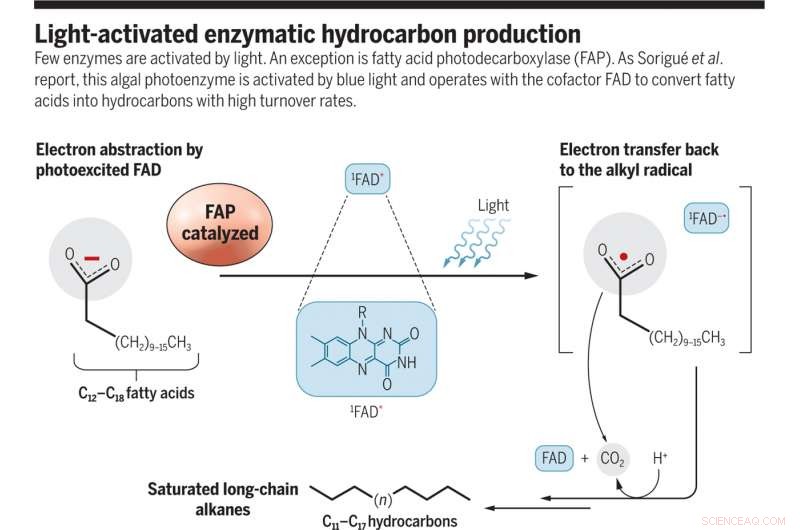
Light-activated enzymatic hydrocarbon production. Credit: (c) A. Kitterman / Science, DOI: 10.1126/science.aao4399
(Phys.org)—A team of researchers affiliated with several institutions in France has discovered an algal photoenzyme that uses blue light to convert fatty acids to hydrocarbons. In their paper published in the journal Science, the team describes their work and the possibility of using their findings as a means for providing a new hydrocarbon energy source. Nigel Scrutton with the University of Manchester offers a Perspective piece in the same journal issue outlining the struggle to harness photochemistry in biology-based manufacturing processes along with overview of the work done by the team in France.
As Scrutton notes, it is rare for photocatalysis to be used in biologically based manufacturing processes. This is due mainly to a lack of biological material that reacts to light in ways that would make them useful in such applications. Notably, many organisms do respond to light, of course, but very few enzymes used by such organisms use light as a direct energy source. In this new effort, the researchers have found an exception—an algal photoenzyme that converts fatty acids to hydrocarbons using blue light and a riboflavin cofactor. The hydrocarbons produced could conceivably be used as an energy source if the procedure can be scaled.
The enzyme was found in the alga Chlorella variabilis and is referred to by the team as a fatty acid photodecarboxylase (FAP), and it works in conjunction with the cofactor flavin adenine dinucleotide (FAD). The team found that the FAP enzyme does its work by uniting the biocatalytic and photoreceptor properties of flavin to catalyze fatty acids through radical chemistry. The result is the removal of carboxyl groups from fatty acids, resulting in the formation of alkanes.
The team reports that they observed the enzyme in action after applying blue light to a protein they had expressed through a sample of E. coli. They also reconstructed the enzyme's crystal structure as a means for discovering how it was bound to fatty acids during catalysis. They further suggest that their work hints at other flavoenzymes might also be phtoenzymes, just waiting to be discovered.
© 2017 Phys.org