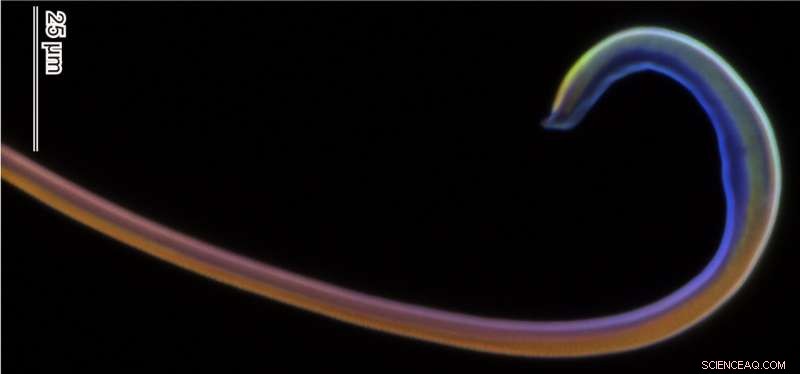
Confocal laser scanning microscope (CLSM) image of the Cassida rubiginosa flagellum tip (25 μm). Credit: Matsumura, Kovalev, Gorb, Sci. Adv. 2017;3: eaao5469
A trio of researchers at Kiel University in Germany has discovered how the male thistle tortoise beetle manages to penetrate the coiled duct inside the female reproductive organ without buckling his flagellum. In their paper published on the open access site Science Advances, Yoko Matsumura, Alexander Kovalev and Stanislav Gorb describe their study of the flagellum and what they found.
The small green male thistle tortoise beetle has a flagellum (male sex organ) that is actually longer than its body—the organ is also very thin and curved at the end. The beetle needs such an organ because of the shape of the female reproductive organ, which includes a coiled duct that the male must penetrate. What is most impressive about the flagellum, the researchers note, is that its tip can make the journey from the outside to the inside without the shaft buckling. This suggested that there was more to the story than could be seen with the naked eye.
To better understand how the beetle flagellum is able to prevent buckling, the researchers lopped off several of them from beetles they had killed and looked at them under a microscope. They noted first that the tip was curved like a fish hook, which is important when maneuvering through a coil, so long as the curve of the flagellum tip matches the curve of the coil. They also found by bending the flagellum at different points along its shaft that it varied in stiffness—the base was quite stiff, but the shaft grew less stiff toward its opposite end. And the tip, they found, was actually rubbery, allowing for flexibility inside the female organ.
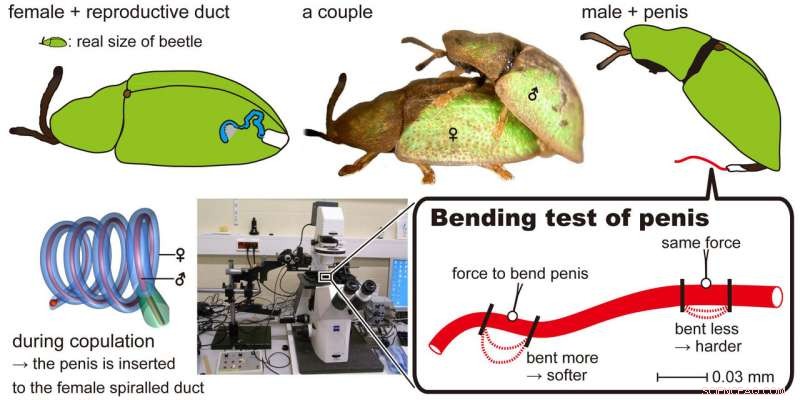
Mating of leaf beetles, its male and female reproductive organs, and new findings on stiffness gradient of the penis found based on a bending test done on a microscope. Credit: Yoko Matsumura, Alexander Kovalev, Stanislav N. Gorb / Matsumura, Kovalev, Gorb
The researchers believe it is both the changing flexibility and rubbery tip that allows the flagellum to move inside the female organ without buckling—a characteristic that could prove useful in human products, such as catheters. Catheters, the team notes, are used in urological, gastrointestinal and cardiovascular medical procedures. Each requires a thin tube to be inserted into a small vessel and slide into it to some degree. Modifying the stiffness of the tubes, the team notes, might help prevent buckling.
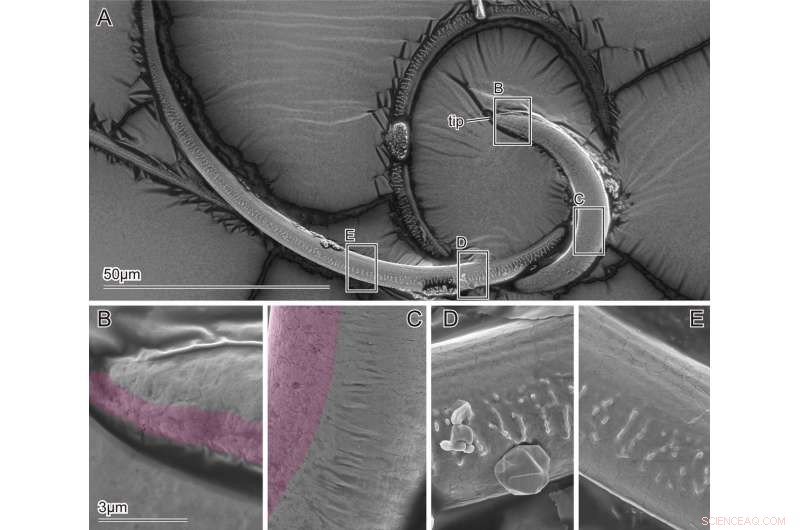
SEM images of the flagellum of Cassida rubiginosa. (A) Map of the images below, the tip of the flagellum. (B to E) Enlarged images of the flagellum corresponding to the squares in (A). The pink-colored areas in (B) and (C) represent shrunk surfaces. The scale bar in (B) is applicable for (C) to (E). Credit: Matsumura, Kovalev, Gorb, Sci. Adv. 2017;3: eaao5469
© 2017 Phys.org