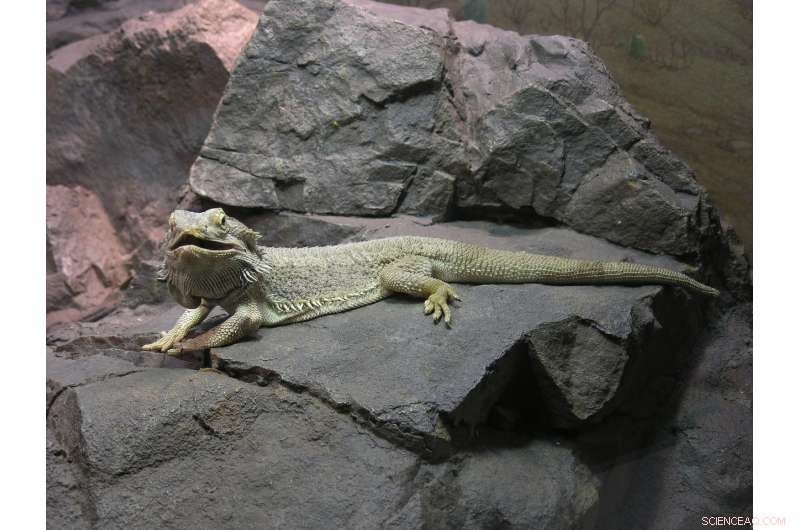
Central bearded dragon. Credit: Greg Hume/Wikipedia/CC BY-SA 3.0
(Phys.org)—A team of researchers affiliated with the University of Lincoln in the U.K. has found evidence suggesting that as the planet heats up due to global warming, the bearded dragon may become less intelligent. In their paper published in the journal Royal Society Open Science, the group describes exposing incubating bearded dragons to warmer than normal air temperatures and then testing their intelligence.
Over the past several years, scientists have been finding that creatures great and small are smarter than commonly assumed. This is the case for bearded dragons, the people-friendly reptile from Australia. Some studies have shown, for example, that they are able to note the behavior of their peers and then copy it if it offers a reward. Such behavior offers a means for testing the intelligence of individuals among a group.
To find out what impact rising temperatures might have on the bearded dragon, the researchers incubated 13 eggs, seven in a warmer than normal 30 degrees Celsius nest and six at the normal 27 degrees C. After they hatched and grew older, the researchers tested the intelligence of all the lizards by exposing them to a video showing a bearded dragon opening a sliding door and then testing them to see if they could or would imitate the behavior for a reward—prior research showed that opening a screen door is something the lizards can only learn if they see another lizard do it first.
The researchers report that fewer of the lizards that incubated in the warmer pens were able to mimic the lizard on the video than those that had incubated at normal temperatures—and those that did succeed did so at a much slower pace. This, the researchers suggest, indicates that as the planet warms, animals across the globe will be impacted in some unexpected ways. For the bearded dragon, it could spell serious trouble if they become less intelligent, making them less able to adapt to change. The researchers also note that their results are similar to those of researcher Jonathan Webb—he found that exposing geckos to warmer temperatures in the nest made them not only duller but less likely to survive once released into the wild.
© 2017 Phys.org