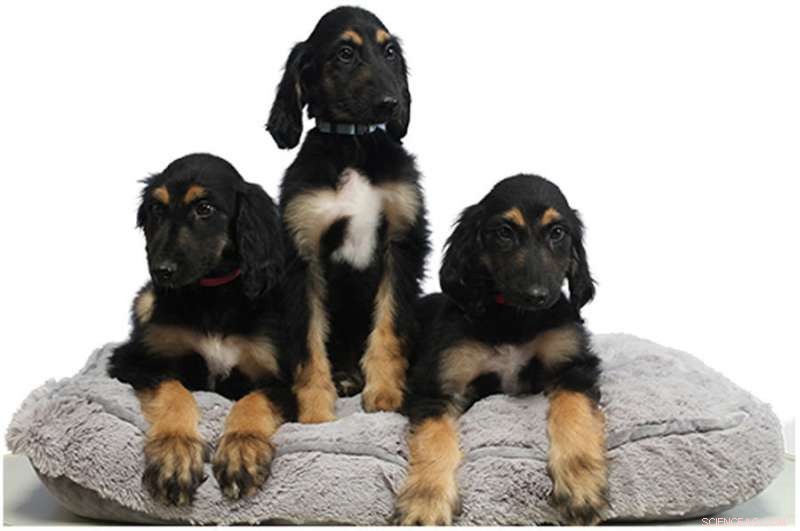
The three surviving reclones at 2 month of age. They were dervived by SCNT of adipose-derived mesenchymal stem cells (ASCs) taken from Snuppy at five years of age. Credit: Scientific Reports (2017). DOI: 10.1038/s41598-017-15328-2
(Phys.org)—A team of researchers with Seoul National University, Michigan State University and the University of Illinois at Urbana-Champaign has re-cloned the first dog to be cloned. In their paper published in the journal Scientific Reports, the group describes duplicating the clone and offers an update on how the dogs are doing.
Back in 2005, researchers at Seoul National University reported that they had cloned an Afghan hound, the first dog to be cloned. Since that time, hundreds of other dogs have been cloned, as well, offering an opportunity to learn more about the potential benefits and possible drawbacks of cloning animals for. Now, in another first, the researchers with this new effort report having cloned the clone they cloned.
The story started with Tai, a normal Afghan hound. The team cloned him by inserting his cells into the eggs of a female donor after removing the original nucleus and then implanting them in the female's uterus. By all accounts, he lived a normal dog life on the campus of Seoul National University, which gave his name: Snuppy. At the age of five, researchers there collected stem cells from Snuppy and used them to inseminate other females. In all, 94 embryos were implanted, which led to four successful pregnancies and births. Shortly thereafter, one of the puppies died, leaving three clones of the cloned dog Snuppy. The researchers wrote a paper describing their results, noting that the dogs, which were nine months old at the time, seemed to be healthy and normal. They have only now published that paper.
The purpose of the research is to learn more about the viability of cloning animals. Despite a lot of research, scientists still do not know for sure if cloned animals suffer unknown birth defects, or if their life spans are shorter than normal animals. There is a growing consensus, however, that cloning results in neither. A lot of animals have been cloned and studied, and thus far, there is little to no evidence indicating that the cloning process introduces flaws. Less work has been done in studying clones of clones, however, which means that others in the cloning community will be watching for reports on the progress of the now seven-year-old dog re-clones very closely.
The researchers note that both Tai and Snuppy died of cancer, though of different types, and that neither was rare or unique. They note also that it is not uncommon for one of a litter of puppies to die, though it is disconcerting that in this case, it was due to a bout of unexplained diarrhea.
© 2017 Phys.org