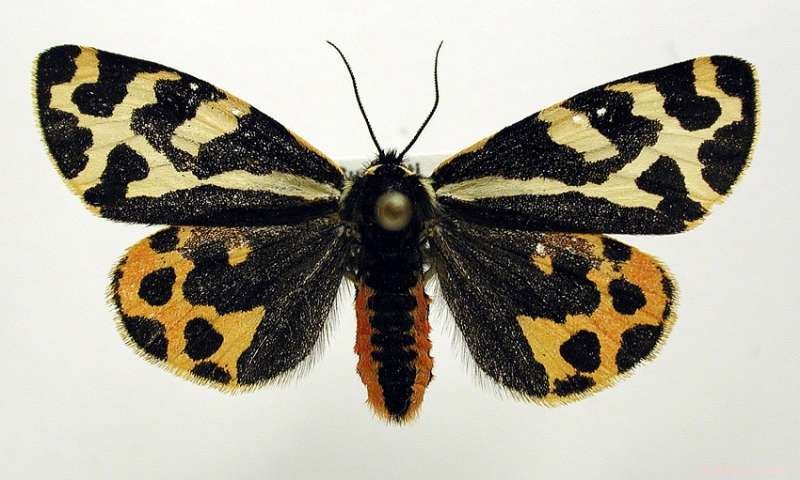
Wood tiger moth. Credit: Wikipedia
(Phys.org)—A team of researchers from the University of Jyväskylä in Finland and Technische Universität Braunschweig in Germany has found that the wood tiger moth secretes two different types of fluids from different parts of its body to ward off two different types of predators. In their paper published in Proceedings of the Royal Society B, the group describes how they studied the moths in their lab and what they learned about them.
Wood tiger moths have coloring reminiscent of the tiger and are found in many parts of the world. In this new effort, the researchers took a closer look at how they ward off predators by collecting multiple specimens and bringing them back to the lab for study.
Prior research had shown that the moths excreted fluid from glands on the backs of their necks—a good location for warding off birds, their main predator. Birds eat moths and catch them by grabbing them by the back of the neck. Anecdotal evidence had suggested that when birds grab a wood tiger moth, they tend to let it go, and have been seen trying to clean their beaks afterwards. Other anecdotal evidence also suggested that ants tend to avoid the moths, likely due to fluid excreted from the moth's anus.
The team started by taking a closer look at the fluid the moths produced from their necks and found that it contained chemical compounds known as pyrazines. The team treated oat flakes with the fluid and fed them to Eurasian blue tits and found that the birds were reluctant to eat them and became averse to them afterwards. The birds willingly ate flakes treated with the anal fluid and sugar water.
Next, the team placed drops of sweetened fluid in disks laid in the path of ants—some of the disks also had chemicals taken from the moths. They report that the ants actually preferred the disks with neck fluid over just the sugar water, but clearly avoided those with anal fluid.
Based on their findings, the researchers conclude that the moths produce different fluid deterrents to ward off different types of predators.
© 2017 Phys.org