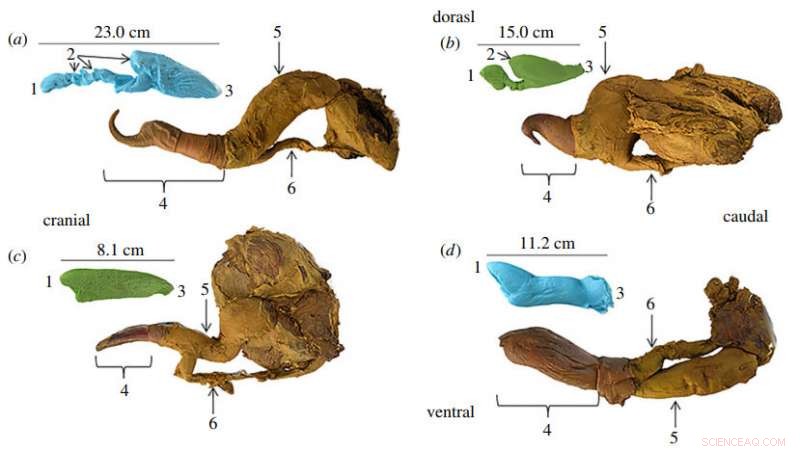
Shape correspondence of male and female genitalia. The silicone vaginal endocast is lined up with the inflated penis tip in sexually mature: (a) harbour Q5 porpoises (Phocoena phocoena), (b) common bottlenose dolphins (Tursiops truncatus), (c) short-beaked common dolphins (Delphinus delphis), and (d) harbour seals (Phoca vitulina). Male and female genital are aligned in the positioning and angle that would enable the deepest penile penetration. Anatomical landmarks identified on the vaginal endocast include the: (1) proximate cervix, (2) vaginal folds, and (3) vaginal opening. Anatomical landmarks identified on the penis include the: (4) penis tip or glans to sheath, (5) penis shaft, and (6) penis retractor muscle. Credit: Proceedings of the Royal Society B: Biological Sciences (2017). DOI: 10.1098/rspb.2017.1265
(Phys.org)—A small team of researchers from Dalhousie University, the University of Massachusetts and Tufts University has learned more about the ways that cetaceans copulate by using parts from dead sea animals to simulate mating in the wild. In their paper published in Proceedings of the Royal Society B, the group describes the various techniques they used to simulate copulation and what they learned from doing so.
As the researchers note, very little work has been done to understand the sexual mechanics of cetaceans—out in the ocean, sex occurs at random times, making the behavior extremely difficult to study. In this new effort, the researchers sought to learn more by simulating copulation using the actual sex organs of deceased animals.
Cetaceans are marine animals that include whales, dolphins and porpoises. And despite our familiarity with all three types, very little is known about the mechanics of how they procreate. For that reason, the researchers worked with fishermen to obtain the bodies of some specimens that had died very recently of natural causes to use as research subjects.
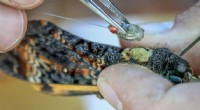
To gain a better understanding of exactly what happens during copulation, the researchers removed the sex organs of several bottlenoses dolphins, common dolphins and harbor porpoises. Penises were inflated with saline solution and then slipped into vaginas to see how they fit and which parts of the organs of one gender interacted with which parts of the other. They also made casts of the various body parts and used them to simulate copulation as well. The team also placed some specimens mid-copulation inside of a CT scanner to create 3-D virtual models of the parts as they actually fit together during different movements that occur as the two animals mate.
The researchers report that they have learned a lot about the physiology of the animals they studied and how the whole process of cetacean copulation works. They also found that with the common dolphin, copulation tended to be what it seemed—a straightforward means of mating. But things were different with the harbor porpoises and bottlenose dolphins—the structure of the vagina was arranged such that the female could channel sperm away from her eggs if she so desired, allowing her to choose which male would inseminate her.
© 2017 Phys.org