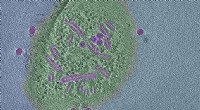
While it appears as long, thin filaments, these filaments are made up of many individual cells connected end-to-end.
Here's why:
* Structure: Spirogyra has a distinct cell wall surrounding each individual cell within the filament.
* Function: Each cell carries out all the essential life functions, including photosynthesis, respiration, and reproduction.
* Organization: The cells are organized in a linear fashion, forming a chain-like structure.
So, even though it looks like a single strand, Spirogyra is actually a multicellular organism.