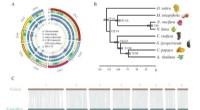
* Common Ancestor: Each branch point (also called a node) on a phylogenetic tree represents a common ancestor. The organisms that descend from this ancestor are grouped together as a clade.
* Shared Ancestry: Organisms that share a recent common ancestor are more closely related than organisms that share a more distant common ancestor. This is reflected in the branching pattern: the closer the branches, the more closely related the organisms.
* Evolutionary Divergence: As organisms evolve, they accumulate differences. These differences can be in their physical characteristics, genetic makeup, or behavior. The branching pattern reflects these evolutionary divergences. Branches that are further apart indicate that those lineages have had more time to diverge and accumulate differences.
* Evolutionary History: The branching pattern of a phylogenetic tree tells us the story of how different organisms have evolved over time. It shows how lineages have split, diversified, and become adapted to different environments.
Example:
Imagine a simple tree with two branches: one leads to monkeys and the other to humans. This branching pattern tells us that:
* Monkeys and humans share a common ancestor.
* Monkeys and humans are more closely related to each other than they are to, say, lizards.
How branching is determined:
* Morphological Data: Scientists use similarities and differences in physical characteristics (anatomy, physiology) to infer relationships.
* Molecular Data: Comparison of DNA and protein sequences is particularly powerful for determining relationships, especially for organisms that may look very different but have similar genetic makeup.
Key Points:
* Branching patterns in phylogenetic trees are not arbitrary but are based on scientific evidence.
* The more data (morphological, molecular) scientists use, the more accurate the phylogenetic tree becomes.
* Phylogenetic trees are constantly being updated as new data emerges and our understanding of evolution improves.
In summary, branching in phylogenetic trees is a visual representation of how organisms are related to each other based on their shared evolutionary history. It helps us understand the patterns of divergence and adaptation that have shaped the diversity of life on Earth.