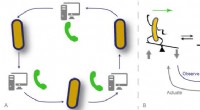
* Cilia: Dynein is a motor protein that "walks" along microtubules, generating the force needed for the beating of cilia. This movement is essential for many functions, such as moving fluids and particles across cell surfaces.
* Vesicles: Dynein also plays a role in intracellular transport, particularly in the movement of vesicles along microtubules. This movement is crucial for delivering cargo, such as proteins and lipids, to different parts of the cell.
While both cilia and vesicle movement rely on dynein, there are slight differences in their specific mechanisms. In cilia, dynein is organized in a complex structure that allows for coordinated movement of multiple microtubules. In vesicle transport, dynein is often part of a larger complex that includes other proteins that help with cargo binding and regulation.