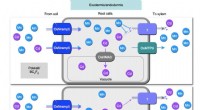
* Passive Transport: Glucose movement into a cell doesn't require energy from the cell. It happens passively along the concentration gradient, meaning glucose moves from an area of high concentration (outside the cell) to an area of low concentration (inside the cell).
* Membrane Protein Assistance: Glucose is a polar molecule and can't easily pass through the cell's lipid bilayer membrane. It needs the help of special membrane proteins called glucose transporters (GLUTs). These proteins bind to glucose and facilitate its movement across the membrane.
In summary: Facilitated diffusion is a type of passive transport that utilizes membrane proteins to help molecules, like glucose, move across the cell membrane.