Here's why:
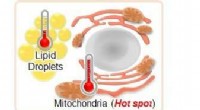
* Oxidative phosphorylation is the final stage of cellular respiration, where electrons are passed along an electron transport chain, generating a proton gradient across a membrane. This gradient is then used to drive the synthesis of ATP by ATP synthase. This process is highly efficient and can produce a large amount of ATP (around 34 ATP molecules per glucose molecule).
* Other processes like glycolysis (2 ATP per glucose) and the Krebs cycle (2 ATP per glucose) produce ATP, but they do so through substrate-level phosphorylation, which is less efficient than oxidative phosphorylation.
Therefore, oxidative phosphorylation, occurring in the mitochondria, is the most efficient ATP-producing process in the cell.