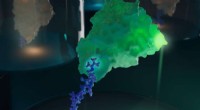
Here's a breakdown:
* Cell membrane: This acts as a barrier between the cell's interior and its environment. It's made up of a phospholipid bilayer with embedded proteins.
* Proteins: These proteins can be specialized to recognize and bind to specific molecules outside the cell. There are two main types involved in this process:
* Receptor proteins: These bind to specific molecules called ligands. Binding to a ligand can trigger a variety of responses within the cell, such as:
* Signal transduction: The signal from the ligand is relayed inside the cell, triggering specific cellular processes.
* Endocytosis: The cell membrane engulfs the ligand and brings it inside the cell.
* Transport proteins: These help move molecules across the cell membrane, either by passive transport (following the concentration gradient) or active transport (requiring energy).
In summary: the cell membrane, with its embedded proteins, is responsible for recognizing and binding to substances outside the cell, allowing the cell to interact with its environment and carry out essential functions.