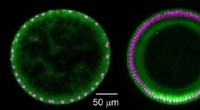
* The cell is likely in interphase. This is the stage of the cell cycle where the cell is not actively dividing. During interphase, the chromosomes are uncoiled and spread out as chromatin, making them too diffuse to be visible under a light microscope.
* The cell may be undergoing mitosis or meiosis, but it is not in prophase, metaphase, or anaphase. During these phases of cell division, chromosomes condense and become visible.
* The cell may be very small. In some cases, even during mitosis, chromosomes may be too small to be visible without specialized techniques.
However, it's important to remember that:
* You cannot definitively determine the stage of the cell cycle just by looking at the chromosomes. Other cellular features or specific staining techniques are needed to confirm the stage.
* There could be other reasons why chromosomes are not visible. For example, the cell may be damaged or dying.
Therefore, the absence of visible chromosomes is an indicator, but not a definitive proof of interphase. Further investigation is needed to understand the cell's state.