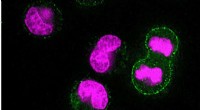
* Size: The nucleus is typically the largest organelle in a eukaryotic cell, taking up a significant portion of the cell's volume.
* Function: The nucleus houses the cell's genetic material (DNA), which controls all cellular activities. This makes it essential for the cell's function and survival.
* Visibility: With proper staining techniques, the nucleus is readily visible under a light microscope.
While the nucleus is prominent, it's important to remember that other structures, like the mitochondria, Golgi apparatus, and endoplasmic reticulum, are also important and visible within the cell.