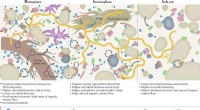
Here's how palisade mesophyll cells contribute to photosynthesis:
* High Chloroplast Concentration: These cells contain a high concentration of chloroplasts, the organelles responsible for capturing light energy.
* Efficient Light Absorption: Their elongated shape and tight arrangement allow them to capture maximum light energy. The cells are oriented perpendicular to the leaf surface, maximizing their exposure to sunlight.
* Increased Surface Area: The elongated shape of the palisade cells provides a larger surface area for absorbing carbon dioxide, a key ingredient in photosynthesis.
In short, palisade mesophyll cells are the primary photosynthetic cells in a leaf, maximizing light capture and carbon dioxide absorption to facilitate efficient energy production.