Here's why:
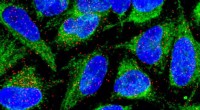
* Eukaryotic cells have a membrane-bound nucleus that houses their DNA. This compartmentalization allows for a more organized and efficient regulation of gene expression.
* Bacteria are prokaryotic cells and lack a true nucleus. Their DNA is located in a region called the nucleoid, which is not enclosed by a membrane.
Therefore, while both eukaryotic and prokaryotic cells contain DNA as their hereditary material, the location of this material differs significantly due to their distinct cellular structures.