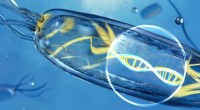
1. Unwinding: The double helix of DNA unwinds, separating the two strands. This is facilitated by enzymes called helicases.
2. Base Pairing: Each single strand of DNA serves as a template for the creation of a new complementary strand. Enzymes called DNA polymerases add free nucleotides to the template strands, following the base pairing rules (adenine with thymine, guanine with cytosine).
3. Leading and Lagging Strands: Because DNA replication occurs in a 5' to 3' direction, one strand (the leading strand) is synthesized continuously. The other strand (lagging strand) is synthesized in short fragments called Okazaki fragments.
4. Joining Fragments: Another enzyme called DNA ligase joins the Okazaki fragments together, forming a continuous strand.
5. Proofreading: DNA polymerases have a proofreading function, ensuring that the newly synthesized DNA strands are accurate copies of the originals.
6. Supercoiling: The newly replicated DNA molecules are then compacted and organized into structures called chromosomes, which are essential for proper cell division.
The result of this intricate process is two identical copies of the original DNA molecule. When cell division occurs, each new daughter cell receives one complete copy of the DNA, ensuring that the genetic information is faithfully passed on to the next generation of cells.