Here's how it works:
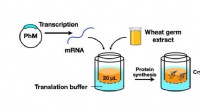
1. Transcription: DNA contains the genetic code for building proteins. In the nucleus, an enzyme called RNA polymerase reads the DNA sequence and creates a complementary copy in the form of mRNA.
2. RNA Processing: The newly synthesized mRNA undergoes modifications like splicing and capping to become mature mRNA.
3. Export: The mature mRNA molecule leaves the nucleus through nuclear pores and enters the cytoplasm.
4. Translation: In the cytoplasm, the mRNA molecule binds to ribosomes, which are cellular machines that read the mRNA code and synthesize proteins.
So, mRNA acts as a messenger, carrying the genetic instructions from the DNA in the nucleus to the ribosomes in the cytoplasm, where the instructions are used to build proteins.