Here's why:
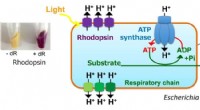
* Prokaryotic cells are simpler and smaller than eukaryotic cells. They lack a nucleus and other membrane-bound organelles.
* Eukaryotic cells have a nucleus containing their DNA, as well as other organelles like mitochondria, chloroplasts (in plants), and Golgi apparatus.
Bacteria have their own unique characteristics and structures, such as:
* Cell wall: A rigid outer layer that provides structural support.
* Plasma membrane: A thin membrane that encloses the cytoplasm.
* Cytoplasm: The gel-like substance that fills the cell.
* DNA: A single, circular molecule of DNA located in a region called the nucleoid.
* Ribosomes: Tiny structures responsible for protein synthesis.
So, while bacteria are living organisms like plants and animals, they belong to a completely separate domain of life called Bacteria, distinguished by their prokaryotic cell structure.