Hydrodynamic Instabilities:
At the center of cytoplasmic streaming lies hydrodynamic instability. This phenomenon occurs when an equilibrium state becomes unstable due to small disturbances and leads to the initiation of flow. Inside an oocyte, different forces act on the intracellular fluid, such as viscosity, density variations, and molecular motor activity. The interaction of these forces under certain conditions generates hydrodynamic instabilities.
Mathematical Modeling:
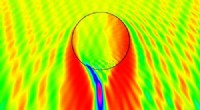
Mathematical models based on fluid dynamics are used to explore the conditions that lead to hydrodynamic instabilities in oocytes. These models describe the fluid's behavior and flow patterns by capturing the interplay of forces at the microscopic level. Computational simulations enable researchers to visualize and analyze the characteristics of the emerging flow fields, leading to a deeper understanding of the physics underlying cytoplasmic streaming.
Emergence of Giant Whirlpools:
Through mathematical modeling, it has been identified that giant whirlpools emerge due to a specific combination of parameters, such as the geometry of the oocyte, viscosity differences within the cytoplasm, and the collective action of molecular motors. For instance, the presence of large fluid-filled chambers within the oocyte, along with localized active forces generated by molecular motors, can create the necessary conditions for instability and flow initiation.
Role of Molecular Motors:
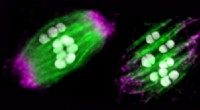
Molecular motors, such as dynein and kinesin, play an essential role in the generation of cytoplasmic streaming. These motor proteins walk along cellular structures called microtubules, transporting vesicles and organelles within the cytoplasm. They exert forces on their surroundings, which contribute to the intricate patterns of cytoplasmic flow. Mathematics describes the behaviors of individual motors and their collective effects on a large scale, allowing researchers to unravel the complexity of such self-organized systems.
Implications for Oocyte Development:
Cytoplasmic streaming in oocytes is believed to have various critical functions related to oocyte maturation and fertilization. It facilitates the transport of nutrients, organelles, and developmental signals throughout the oocyte, thereby regulating cellular organization. Moreover, disruptions to cytoplasmic streaming due to genetic mutations have been linked to infertility and developmental abnormalities, underlining its importance in reproductive health.
The mathematical analysis of cytoplasmic streaming in oocytes brings together principles of fluid dynamics, cell biology, and computational biology. By elucidating the physical mechanisms underlying these giant whirlpools, mathematics contributes to a comprehensive understanding of oocyte development and provides new insights into the complex processes fundamental to life.