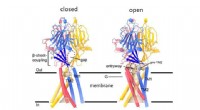
The researchers found that dynamin assembles into a helical polymer that wraps around the neck of a membrane tubule. The polymer then undergoes a conformational change that causes the membrane tubule to constrict and eventually break apart. The researchers believe that this conformational change is driven by the binding of GTP to dynamin, which alters the interactions between the dynamin molecules in the polymer.
The findings of this study provide new insights into the mechanism by which dynamin mediates membrane constriction and scission. This information could be used to develop new drugs that target dynamin function, which could potentially be used to treat a variety of diseases, including cancer, neurodegenerative disorders, and infectious diseases.
The study was conducted by a team of researchers from the University of California, Berkeley, the University of California, San Francisco, and the Howard Hughes Medical Institute. The results were published in the journal Nature.