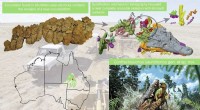
Recent studies have highlighted the challenges in accurately detecting evidence of early life in the fossil record. For instance, putative microfossils from the 3.5-billion-year-old Dresser Formation in Western Australia, interpreted by some as evidence for the earliest life on Earth, have come under scrutiny due to their ambiguous morphologies and alternative explanations for their formation. Similarly, alleged biosignatures in hydrothermal vent deposits from the 3.2-billion-year-old Barberton Greenstone Belt in South Africa have been questioned based on their geochemical characteristics and the lack of convincing cellular structures.
These examples illustrate that discerning between true biosignatures and geological artifacts can be extremely difficult, especially in ancient rocks where fossilization processes are poorly understood. Researchers must exercise rigorous criteria and employ multiple lines of evidence to validate potential signs of early life. This cautious approach is essential to avoid making false positive claims that could hinder our understanding of the true origins and evolution of life on Earth.